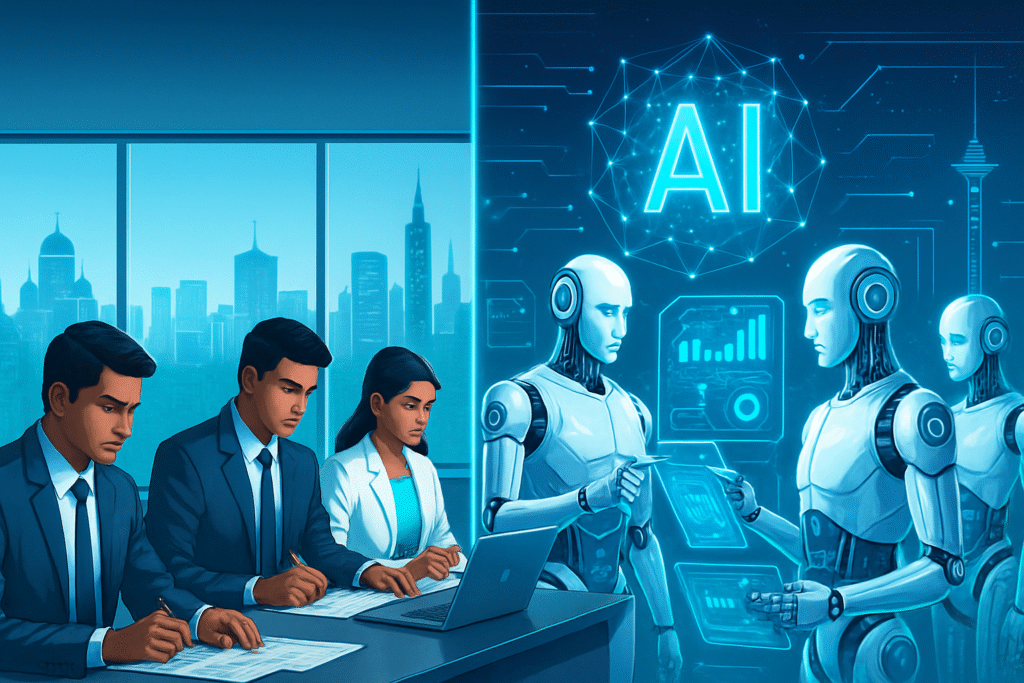
Imagine this:
You walk into your office on a Monday morning, coffee in hand, and instead of your team sending you reports, an AI tool has already generated them overnight. That social media post you were planning to brainstorm? The AI drafted five catchy versions before you even logged in. Sounds convenient, right? But it also raises a big question—where does that leave you as a professional?
This is not a scene from a sci-fi movie. It’s happening today in India’s offices—whether in IT parks in Bengaluru, financial hubs in Mumbai, or co-working spaces in Gurugram. Artificial Intelligence (AI) is no longer just a tech buzzword; it’s quietly reshaping how white-collar jobs are done.
Why does this matter for working professionals in India?
Because India is home to one of the largest white-collar workforces in the world, covering roles in:
-
IT & software services
-
Finance & accounting
-
Marketing & advertising
-
Consulting & legal
-
Healthcare & education
These sectors have been India’s growth engine for decades. But now, AI tools—from chatbots to generative AI like ChatGPT—are changing the rules of the game.
The Double-Edged Sword of AI
-
On one side, AI promises to make work easier by handling repetitive tasks.
-
On the other, it sparks fear: “Will AI take away my job?”
Both sides are true to some extent. AI is not just about job loss—it’s about job transformation. Some roles will shrink, others will evolve, and many new ones will be born.
A Story You’ll Relate To
Take Rohit, a 32-year-old financial analyst in Pune. A year ago, most of his time went into crunching numbers in spreadsheets. Today, his company uses AI-powered analytics software that does this in seconds. At first, Rohit worried his role might become irrelevant. But instead of resisting, he started learning how to use AI insights to make better investment recommendations. Now, he’s more valuable than ever—not because he replaced AI, but because he works with AI.
What You’ll Learn in This Blog
This blog dives deep into the AI impact on white collar jobs in India, answering the big questions every professional is asking:
-
Which jobs are at risk?
-
Which jobs will grow stronger with AI?
-
What skills should you learn to stay relevant?
-
How are Indian companies and the government preparing for this shift?
By the end, you’ll see that the real threat isn’t AI itself—it’s ignoring it. Those who embrace AI will move ahead; those who don’t may fall behind.
👉 In short: AI is here to stay, and it’s reshaping the future of work in India. The smart move is not to fear it, but to understand it, adapt to it, and grow with it.
Contents
- 1
- 2 Understanding White-Collar Jobs in India
- 3 How AI is Impacting White Collar Jobs in India
- 4 Jobs Most at Risk vs. Jobs Enhanced by AI
- 5 Skills Future-Proofing White Collar Professionals in India
- 6 Case Studies & Real-World Examples
- 7 Opportunities AI Brings for Indian Professionals
- 8 How to Adapt: Action Plan for Indian White Collar Workers
- 9 Government & Industry Initiatives in India
- 10 Conclusion: The Road Ahead for White Collar Professionals in India
- 11 FAQs
- 11.1 1. What is the impact of AI on white collar jobs in India?
- 11.2 2. Will AI replace jobs in IT and finance in India?
- 11.3 3. Which skills should professionals learn to survive AI disruption?
- 11.4 4. How are Indian companies using AI in the workplace?
- 11.5 5. What future jobs will AI create in India?
Understanding White-Collar Jobs in India
When we talk about white-collar jobs in India, the first images that often come to mind are professionals dressed in formal wear, working in glass buildings, typing away on laptops, or joining back-to-back Zoom calls. But white-collar jobs are much more than just corporate stereotypes—they form the backbone of India’s knowledge economy.
What Are White-Collar Jobs?
-
These are jobs that typically involve mental work instead of physical labor.
-
They rely on skills such as analysis, decision-making, creativity, or communication.
-
Examples include:
-
IT engineers & software developers
-
Accountants & finance professionals
-
Consultants & business analysts
-
Marketing & advertising executives
-
Lawyers & legal consultants
-
HR managers & recruiters
-
Designers, researchers, educators, and many more
-
In short, if your job requires more time on a keyboard than on heavy machines, you are most likely a white-collar professional.
Why White-Collar Jobs Matter in India
India has one of the largest pools of white-collar workers in the world. Here’s why:
-
IT and outsourcing boom: Over the last two decades, companies like Infosys, TCS, and Wipro turned India into a global outsourcing hub. Millions of Indians started working in IT services, BPOs, and consulting.
-
Financial services & banking growth: With a growing middle class, India’s BFSI (Banking, Financial Services & Insurance) sector expanded rapidly, creating millions of office jobs.
-
Startups & digital economy: India now has 100+ unicorn startups, many in tech-driven fields like fintech, edtech, and healthtech—all hiring white-collar professionals.
-
Global integration: From investment banks in Mumbai to remote SaaS workers in Bengaluru, Indian professionals are contributing to the global economy every day.
A Small Story Many Can Relate To
Take the story of Ritika, a 28-year-old marketing executive in Bengaluru. She spends her weekdays:
-
brainstorming ad campaigns,
-
analyzing customer insights, and
-
coordinating with her design team over Slack.
Her father, on the other hand, worked as a government school teacher for 35 years—also a white-collar role, but in a completely different era. Ritika’s world looks very different: digital tools, global clients, and AI-driven marketing dashboards.
This small comparison shows how much white-collar work in India has evolved in just one generation.
The Scale of White-Collar Work in India
-
IT & Business Process Management (BPM) alone employs over 5 million people.
-
Banking & financial services add millions more.
-
Add to that professionals in consulting, law, education, healthcare, startups—and the numbers keep climbing.
For India’s middle class, white-collar jobs are not just about salaries—they represent aspiration, stability, and upward mobility. For many families, getting a son or daughter into an IT firm, a bank, or a consulting company has been the ticket to better housing, education, and lifestyle.
But Here’s the Catch…
The very jobs that symbolized growth and security for millions of Indians are now at a crossroads. With the rise of Artificial Intelligence, many repetitive and routine tasks are getting automated. That’s why it’s crucial for us to not only understand the nature of white-collar jobs but also to be aware of how they are changing in today’s AI-driven era.
✨ In this section, we’ve set the context: white-collar jobs in India are vast, diverse, and deeply linked to the country’s growth story. Next, we’ll dive into how AI is reshaping them—some jobs are under risk, while others are being supercharged with new opportunities.
How AI is Impacting White Collar Jobs in India

If you’re a working professional in India today, chances are you’ve already come across AI at work — whether it’s in the form of chatbots on customer calls, AI-driven dashboards, or tools like ChatGPT, Jasper, or MidJourney that your colleagues are experimenting with.
AI is no longer a “future technology.” It’s quietly becoming part of our daily work lives. And the impact is being felt strongly in white collar jobs across industries like IT, finance, marketing, HR, consulting, and even law.
Here’s how AI is reshaping things right now:
🔹 1. Automating Repetitive & Mundane Tasks
-
Think about the hours spent making reports, entering data, or scheduling meetings.
-
AI tools are now taking over these routine, time-consuming activities.
-
Example: Many Indian IT companies are using AI-powered RPA (Robotic Process Automation) to handle payroll, invoice processing, and compliance reports.
👉 Impact: Professionals spend less time on “boring work” and more on strategy and problem-solving.
🔹 2. Smarter Decision-Making in Offices
-
Finance teams now rely on AI to detect fraud faster than humans ever could.
-
HR managers use AI tools to analyze employee performance and predict attrition.
-
Business analysts can process huge amounts of customer data in minutes.
👉 Impact: Decisions are faster, more data-driven, and often more accurate. But it also means junior analysts who only did “number crunching” must upskill.
🔹 3. Generative AI in Creative & Marketing Roles
-
AI isn’t just for numbers — it’s also becoming creative!
-
Marketers are using ChatGPT to draft emails, ad copies, and presentations.
-
Designers use AI tools like Canva AI or MidJourney to create quick visual mock-ups.
-
A digital marketing executive from Bangalore shared that using AI has cut her team’s campaign preparation time by almost 40%.
👉 Impact: Creative jobs are being reshaped. Instead of spending hours starting from scratch, professionals now focus on strategy and final polishing.
🔹 4. Customer Service & Call Centers
-
India’s BPO sector has been a global hub for customer service. But AI-powered chatbots and voice assistants are now handling basic queries 24/7.
-
For example, banks like HDFC and ICICI already use AI chatbots to answer common customer questions instantly.
👉 Impact: Entry-level customer service jobs are at risk, but new roles are opening up in AI training, chatbot management, and customer experience design.
🔹 5. Legal & Compliance Automation
-
Law firms and corporate legal teams in India are using AI tools to scan thousands of pages of contracts in seconds.
-
Compliance officers rely on AI for tracking regulation changes automatically.
👉 Impact: Junior associates who spent hours scanning documents will need to shift towards advisory and strategic roles.
A Quick Story from India 💡
Ravi, a 28-year-old financial analyst in Pune, used to spend most of his time building spreadsheets and generating reports. Last year, his company adopted an AI-driven analytics tool. At first, Ravi was worried his job would vanish. But instead of making him redundant, the tool freed him from the repetitive number-crunching. Now Ravi spends his day interpreting insights, meeting clients, and suggesting investment strategies — tasks that require human judgment.
⚖️ The Big Picture
AI is not here to take away every job — but it is changing the nature of jobs. For many professionals, AI is like a co-worker who can handle repetitive tasks faster. The challenge (and opportunity) lies in learning to work with AI, not against it.
👉 In short:
-
Low-value, repetitive tasks → automated.
-
High-value, human skills → amplified.
-
New opportunities → being created.
Jobs Most at Risk vs. Jobs Enhanced by AI
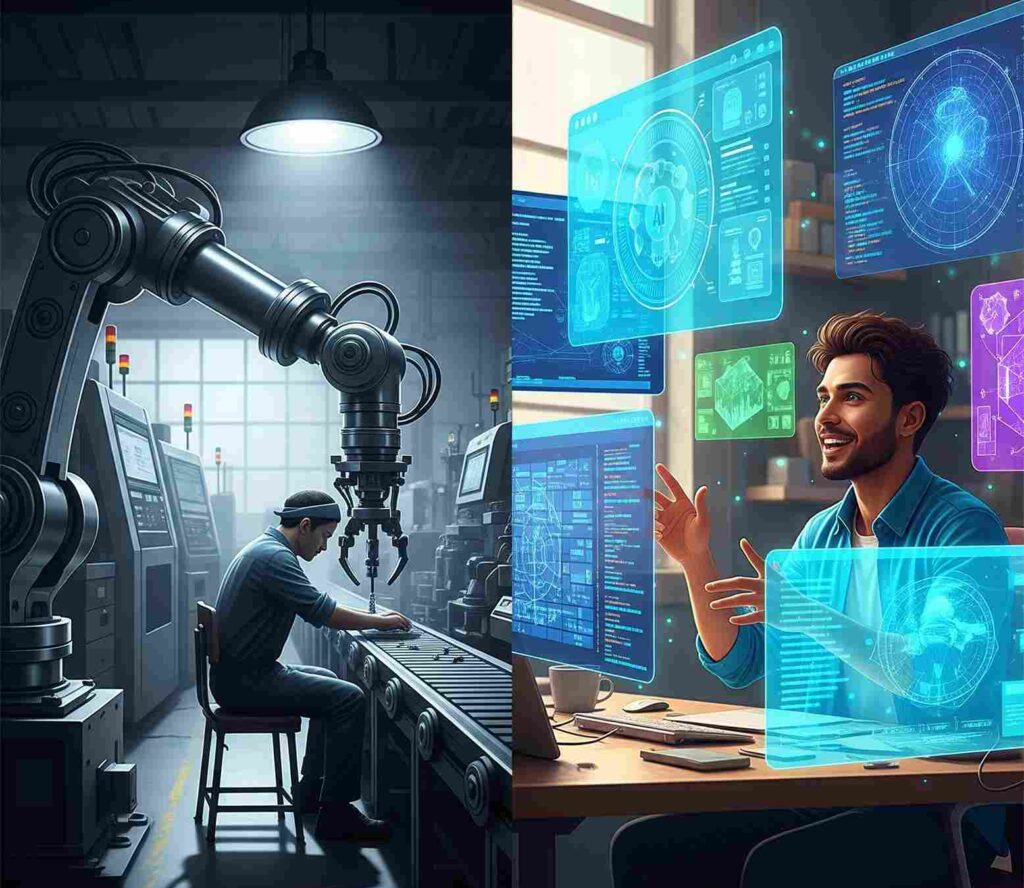
When people hear “AI is taking over jobs”, the first reaction is usually fear. But the truth is more nuanced. AI is not here to completely “steal” every job—it’s here to transform how jobs are done. Think of it like when computers arrived in offices: some typing jobs disappeared, but millions of new IT careers were born.
The same story is unfolding with AI in India today. Some roles are at higher risk of automation, while others are becoming even more valuable with AI as a partner.
Jobs Most at Risk from AI in India
These are roles where the bulk of tasks are repetitive, rule-based, and data-heavy.
-
Data Entry Clerks & Back-Office Roles
-
Why at risk? Because AI can process forms, update records, and extract data faster and error-free.
-
Example: A large Indian bank is now using AI bots to handle KYC documentation—work that used to need dozens of junior staff.
-
-
Customer Support Executives
-
Chatbots and voice AI are handling FAQs and routine customer queries.
-
Call centers in India are already integrating AI tools that can answer 70% of basic queries, leaving only complex issues to humans.
-
-
Junior Analysts
-
Basic reporting, number crunching, and Excel-based analysis can be automated by AI-powered dashboards.
-
Companies prefer analysts who can go beyond the numbers—telling stories, interpreting insights, and advising business leaders.
-
-
Content Writers (Basic Level)
-
AI tools can generate product descriptions, emails, and SEO drafts in seconds.
-
The risk is highest for entry-level writing jobs that don’t require much creativity or original thought.
-
📌 Story:
Imagine Rohan, a fresh graduate who joined a BPO in Bengaluru. His job was to manually update customer complaints into spreadsheets. Within a year, the company introduced an AI tool that automated 80% of the work. Rohan’s role shrank overnight. But instead of panicking, he took up a short data visualization course. Today, he works in the same company but as a business insights associate—a role AI can’t fully replace.
Jobs Being Enhanced (Made More Valuable) by AI
Now for the positive news: many white-collar jobs are not being replaced but are actually getting supercharged by AI.
-
IT Developers & Software Engineers
-
AI helps with code suggestions, bug fixes, and testing.
-
But human developers still design architectures, solve complex problems, and innovate.
-
In India’s booming IT sector, those who learn to co-pilot with AI tools will stay in demand.
-
-
Financial Analysts & Consultants
-
AI can crunch market data and predict trends, but it can’t replace human judgment.
-
Clients still want trusted advisors who can mix AI insights with business context.
-
-
Marketing & Creative Professionals
-
Instead of replacing marketers, AI is becoming a creative assistant.
-
Example: An Indian startup used AI to generate ad variations and test them quickly, but it still needed humans to pick the right emotional angle.
-
-
Healthcare & Legal Professionals
-
AI can scan medical images or sift through case laws, but only a doctor or lawyer can interpret and advise responsibly.
-
These fields are moving towards AI + Human collaboration rather than replacement.
-
📌 Analogy to Remember:
AI in the workplace is like having a super-smart intern—great at repetitive work, lightning-fast at research, but still needing a mentor (you!) to guide, refine, and make final decisions.
Key Takeaway for Indian Professionals
AI’s impact on white collar jobs in India is not a one-sided story of loss. Yes, some routine roles will shrink, but many jobs will actually expand in scope and value. The biggest winners will be those who:
-
Learn to work with AI instead of against it.
-
Upgrade skills from doing tasks to solving problems.
-
Use AI as a tool to become faster, sharper, and more creative.
In other words: AI won’t replace you. But a professional who knows how to use AI might.
Skills Future-Proofing White Collar Professionals in India
Imagine this: You’re an experienced project manager in Bengaluru. Suddenly, a colleague shows you how an AI tool prepared in minutes what used to take you three hours—status reports, risk analysis, even presentation slides.
Your first reaction? A mix of amazement and fear.
But here’s the truth: AI isn’t here to take away your job—it’s here to change how your job is done. And the professionals who thrive will be the ones who add skills that AI can’t replace.
So, what exactly should you focus on? Let’s break it down.
🔑 1. AI Literacy & Comfort with Digital Tools
-
You don’t need to become a coder, but you do need to understand AI basics.
-
Learn how AI tools work, their strengths, and their limitations.
-
Get hands-on with tools like ChatGPT, Bard, Jasper, or even AI-powered Excel.
-
Example: A finance executive who knows how to prompt AI for financial summaries can work faster and smarter than one who doesn’t.
👉 Think of it like Excel in the 90s—those who adopted it early moved ahead, those who resisted struggled.
📊 2. Data Analysis & Critical Thinking
-
AI can crunch numbers, but it can’t always interpret them in the right business context.
-
Skills like reading data, spotting patterns, and questioning results are gold.
-
Example: A marketing manager in Mumbai might use AI to generate campaign insights but still needs to decide which idea will resonate with Indian customers.
👉 The future belongs to professionals who can say: “This is what the data says, but this is what it means for us.”
🧠 3. Soft Skills – The Human Edge
AI might write an email draft for you, but can it:
-
Negotiate with a tough client?
-
Motivate a team going through layoffs?
-
Build trust in a boardroom?
Soft skills like empathy, communication, negotiation, and leadership are what set professionals apart.
-
A lawyer in Delhi may use AI for legal research, but winning a client’s trust still depends on human connection.
👉 The more “human” your role, the safer your career is.
📚 4. Continuous Learning & Upskilling
The old habit of getting a degree and stopping learning won’t work anymore.
-
Upskill with short-term online courses on AI, machine learning, digital marketing, data visualization, cybersecurity.
-
Platforms to explore:
-
Coursera & edX – global certifications
-
NPTEL & SWAYAM – Government of India’s e-learning
-
UpGrad, Simplilearn – Indian edtech platforms
-
LinkedIn Learning – quick skills for professionals
-
👉 A mid-career HR professional in Pune who learns AI-driven HR analytics instantly becomes future-ready compared to peers.
🚀 5. Adaptability & Growth Mindset
-
Technology will keep evolving—AI today, maybe quantum computing tomorrow.
-
The real skill is staying adaptable, curious, and open to new ways of working.
-
Example: Many call center jobs in India are evolving into AI supervision roles—where humans oversee chatbots, train them, and handle complex queries.
👉 If you resist change, you risk being left behind. If you embrace it, you’ll always find opportunities.
✨ A Simple Mantra for Indian Professionals
AI may be smart, but it lacks judgment, creativity, and emotional intelligence.
Your career will stay future-proof if you combine:
-
Tech + Human skills
-
Knowledge + Curiosity
-
Efficiency + Empathy
In other words: Don’t compete with AI—collaborate with it.
✅ By building these skills, working professionals in India can shift from fearing AI to using it as a career accelerator.
Case Studies & Real-World Examples
When we talk about the impact of AI on white-collar jobs in India, it can sometimes feel like a distant “future problem.” But the truth is—it’s already happening around us. Big companies, startups, and even small firms have begun weaving AI into daily workflows. Let’s look at some real-world examples of how AI is transforming different industries in India.
🏢 1. IT Giants: Infosys, TCS, and Wipro
-
What’s happening?
India’s biggest IT services companies are no strangers to automation. For years, they’ve been using robotic process automation (RPA) for repetitive coding, testing, and documentation. -
AI shift now:
-
Infosys launched AI-powered platforms to reduce manual code generation.
-
TCS is using AI in project management, predicting delays and optimizing staffing.
-
Wipro set up AI CoEs (Centers of Excellence) where employees get trained to use generative AI tools for client work.
-
-
Impact on jobs:
Junior-level repetitive tasks are slowly being automated, but employees who learn to work with AI are becoming more valuable.
💡 Story to relate: Imagine a fresher at Infosys who used to spend weeks manually testing lines of code. Today, with AI testing tools, the same task takes hours. Instead of worrying, that fresher now spends time designing better solutions for clients—work that feels more meaningful.
💳 2. BFSI Sector: Banks and Financial Services
-
What’s happening?
Leading banks like HDFC and ICICI use AI for fraud detection, loan approvals, and customer support. -
AI in action:
-
Fraud detection: AI scans thousands of daily transactions in real time to flag unusual activities.
-
Loan processing: What used to take days of paperwork now takes minutes, thanks to AI-driven risk assessment models.
-
Customer service: Chatbots on banking apps resolve simple queries 24/7.
-
-
Impact on jobs:
Routine roles in call centers and back-office processing are shrinking. But at the same time, risk analysts, AI auditors, and financial advisors are in demand.
💡 Story to relate: A loan officer who earlier spent hours verifying documents now uses an AI dashboard. Instead of manual checks, they spend more time talking to customers and helping them choose the right financial product.
📢 3. Marketing & Advertising Agencies
-
What’s happening?
Digital-first agencies in Bengaluru, Mumbai, and Gurugram are experimenting heavily with generative AI for content creation, design drafts, and ad targeting. -
AI in action:
-
Content teams use AI to create first drafts of blogs, product descriptions, and social media posts.
-
Design teams experiment with AI tools like MidJourney for creative mockups.
-
Ad managers rely on AI-driven analytics to refine targeting and reduce ad spend.
-
-
Impact on jobs:
Junior copywriters and designers may feel the pinch, but senior professionals who guide AI outputs are thriving.
💡 Story to relate: A young marketing associate once spent nights drafting 50 captions for a campaign. Now, AI suggests those captions in seconds. The associate’s role? Pick the best ones, tweak them with creativity, and brainstorm big-picture campaign ideas.
⚖️ 4. Legal & Compliance Sector
-
What’s happening?
Law firms and corporate legal teams are beginning to adopt AI for document review, contract drafting, and compliance checks. -
AI in action:
-
AI tools scan through thousands of pages of contracts to highlight risky clauses.
-
Compliance teams use AI dashboards to stay updated on new regulations.
-
-
Impact on jobs:
Routine research tasks that juniors did are shrinking, but lawyers skilled in negotiation and courtroom work remain irreplaceable.
💡 Story to relate: A junior lawyer at a Delhi law firm once had to read 200 pages of contracts before a deal signing. Today, AI highlights the 5 risky clauses instantly. That junior lawyer can now focus on advising clients instead of drowning in paperwork.
🚀 5. Startups & the Indian Entrepreneurial Spirit
-
What’s happening?
India’s startup ecosystem is one of the fastest adopters of AI. From AI-driven edtech tools to healthcare chatbots, small teams are using AI to compete with larger firms. -
Examples:
-
Health-tech startups using AI chatbots to provide instant medical advice.
-
Edtech startups personalizing learning paths using AI.
-
HR-tech startups using AI to screen CVs and predict candidate fit.
-
-
Impact on jobs:
Startups may not hire big teams for manual tasks anymore, but they’re creating new-age roles like AI trainers, data engineers, and product designers.
💡 Story to relate: A three-member startup in Pune couldn’t afford a big customer support team. They integrated an AI chatbot. Customers were happy with faster responses, and the founders could focus on growth. Instead of cutting jobs, they reallocated funds to hire a product manager and a UX designer.
✅ Key Takeaway from the Case Studies
Across industries, one pattern is clear: AI is taking over repetitive, rule-based tasks, while creating space for higher-value, human-driven work. Professionals who embrace AI as a co-worker, not a competitor, are the ones staying ahead.
Opportunities AI Brings for Indian Professionals

Whenever we hear about AI, the first reaction is often fear:
“Will this replace my job? What if machines take over everything I do?”
But here’s the reality: AI is not just about replacing jobs — it’s about creating new opportunities. If you look closely, the rise of AI in India is opening doors for professionals who are ready to adapt and grow.
Let’s break this down 👇
🚀 1. Higher Productivity, Less Stress
Think about your daily work routine. How much time do you spend on:
-
Drafting routine emails?
-
Creating reports or presentations?
-
Searching for data?
AI can now take over repetitive tasks, freeing you to focus on the creative, strategic, and people-driven parts of your role.
👉 Example: A marketing manager at a Bengaluru startup uses AI tools to generate first drafts of campaign ideas. Instead of spending hours brainstorming, she spends more time refining ideas, connecting with clients, and leading her team.
Result? Better work-life balance + stronger career growth.
💼 2. Rise of New AI-Centered Roles
Just like the IT boom in the 2000s created new job titles, AI is bringing fresh career paths:
-
AI Trainers & Prompt Engineers – guiding AI systems to give better outputs.
-
AI Project Managers – managing adoption of AI within companies.
-
AI Ethics Specialists – ensuring fairness, safety, and compliance.
-
Data & AI Analysts – interpreting AI-driven insights for business.
👉 The beauty? These aren’t just for coders. Even professionals from finance, HR, law, or marketing backgrounds can pivot into these roles with the right training.
🌏 3. Global Opportunities for Indian Talent
India has always been a powerhouse for global services. With AI, this edge is growing.
-
Remote-first jobs: Global firms now hire Indian professionals who can manage AI-powered systems.
-
Freelancing & side hustles: A copywriter in Pune or a designer in Kochi can use AI tools to deliver world-class work to international clients at competitive rates.
-
Startups going global: Indian entrepreneurs are building AI tools that solve problems not just in India, but worldwide.
👉 Imagine an HR professional in Delhi using AI recruitment tools to manage hiring for a Silicon Valley company — without leaving her home country. That’s the power AI unlocks.
💡 4. AI as a Partner in Creativity
AI is not just about numbers and data; it’s also fueling creativity.
-
Writers use AI to brainstorm plot ideas.
-
Designers get instant visual mockups.
-
Teachers create personalized learning plans with AI.
👉 Story: A young architect in Mumbai uses AI-powered design tools to generate multiple building layout ideas in minutes. Instead of struggling with just one design, he now has ten creative options to refine and pitch to clients. His clients see him as more innovative, and his projects win faster approvals.
📈 5. Career Growth Through Upskilling
The professionals who embrace AI are climbing faster in their careers. Why? Because companies want people who:
-
Know how to use AI tools effectively.
-
Can guide teams on blending human skills with machine power.
-
Bring efficiency and cost savings.
👉 Companies like Infosys, TCS, and Wipro are already training employees in AI. If you’re proactive in learning, you’ll be seen as an “AI-ready professional”, which directly boosts your chances for promotions, better pay, and leadership roles.
✅ The Takeaway
AI is not a threat — it’s a career multiplier. For Indian professionals, the real opportunity lies in:
-
Working smarter, not harder.
-
Exploring brand-new job titles.
-
Grabbing global opportunities from your laptop.
-
Boosting creativity and innovation.
-
Accelerating career growth through upskilling.
The world of work is changing fast, but here’s the good news:
AI won’t replace you — it will empower the version of you that’s willing to learn, adapt, and grow.
How to Adapt: Action Plan for Indian White Collar Workers
When ChatGPT first launched, a mid-level marketing professional in Bangalore told me—
“I thought AI would steal my job. But soon I realized, it’s like having a super-smart intern who works 24×7. The trick is to guide it well.”
That’s the essence: AI isn’t here to push you out—it’s here to push you forward. But only if you learn how to adapt.
Here’s a practical action plan tailored for Indian white-collar workers:
1. Accept That AI is Here to Stay
-
AI isn’t a passing trend—it’s the new electricity of the workplace.
-
Instead of resisting, see it as an ally. Just like Excel replaced calculators, AI will replace repetitive mental work.
-
Mindset shift: “AI won’t take my job, but someone who knows AI might.”
2. Audit Your Job Tasks
Take a notebook and break your daily work into two buckets:
-
✅ Repetitive tasks: reports, scheduling, data crunching, drafting basic emails.
-
🌟 Human-first tasks: strategy, negotiation, empathy, leadership, creativity.
👉 The first set is where AI shines. The second is where you shine.
Example:
A finance analyst in Mumbai found that 40% of his time was spent cleaning spreadsheets. By automating it with AI tools, he freed up hours for deeper client analysis.
3. Upskill in AI & Complementary Skills
-
Learn the basics: AI tools, prompt writing, data literacy.
-
Explore short-term certifications from Coursera, UpGrad, IIT-NPTEL, or even YouTube.
-
Focus on skills that AI can’t fully replace: leadership, design thinking, emotional intelligence.
💡 “If you want a faster, structured way to become AI-ready and turn those skills into salary hikes, check out our complete “AI Job Security Accelerator” with plug-and-play trackers, templates & negotiation guides.” CLICK HERE
Pro tip: Even dedicating 30 minutes a day to learning AI tools can put you ahead of 90% of your peers in the next 2 years.
4. Use AI to Boost Your Own Productivity
Don’t wait for your company to give you AI tools—start experimenting today.
-
Writers → use ChatGPT to brainstorm blog outlines.
-
HR professionals → use AI for resume screening.
-
Consultants → use AI for data visualization.
-
Salespeople → use AI for personalized pitch emails.
Mini Story: A content manager in Delhi cut her article drafting time from 5 hours to 2 by using generative AI for first drafts, then polishing with her expertise.
5. Network & Stay Future-Ready
-
Join LinkedIn groups, attend webinars, and follow AI thought leaders.
-
Share your AI learnings with peers—this builds your brand as an early adopter.
-
Explore cross-functional projects at work where AI is being tested.
👉 The professionals who stay connected and adaptable will spot opportunities before others.
Quick Recap: The 5-Step Action Plan
-
Accept AI as your workplace ally.
-
Audit your job—what AI can do vs. what only you can.
-
Upskill in AI + human-first skills.
-
Use AI daily to boost productivity.
-
Stay connected, curious, and future-ready.
💡 Final Thought:
Think of AI as a new language. Those who learn it early will speak it fluently and lead the conversation. Those who ignore it may soon struggle to keep up. As a white-collar professional in India, your biggest power is not to compete with AI—but to collaborate with it and amplify your human edge.
Government & Industry Initiatives in India
When it comes to the AI impact on white collar jobs in India, one thing is clear: you’re not alone in figuring this out. Both the Indian government and large companies know that the workplace is changing fast—and they’re already investing in programs to help professionals adapt.
Let’s break it down.
🏛 Government Initiatives: Building an AI-Ready India
The government has realized that AI isn’t just a tech trend—it’s the future of work. That’s why several programs are in place to help professionals and students prepare:
-
Digital India Mission – This flagship program has gone beyond just internet access. The focus is now on AI-powered services in healthcare, agriculture, and education. For professionals, it means more AI-driven jobs in public and private sectors.
-
National AI Strategy (NITI Aayog) – In 2018, NITI Aayog released a blueprint called “AI for All.” Its goal: make India a global AI hub. The plan highlights priority areas like healthcare, agriculture, smart cities, and education—all of which open up new career opportunities.
-
FutureSkills PRIME (MeitY + NASSCOM) – A joint initiative where working professionals can upskill in AI, data science, and cloud computing. Many courses here are government-subsidized, making them accessible even if you’re mid-career.
-
Skill India & PMKVY (Pradhan Mantri Kaushal Vikas Yojana) – These programs have started adding AI and digital skills modules, helping professionals and fresh graduates stay job-ready.
👉 Think of it like this: A few years back, IT workers in India had to quickly learn cloud computing when it disrupted the industry. Today, AI is the new “cloud moment”, and the government is giving you the ladder to climb, rather than letting you swim alone.
🏢 Industry Initiatives: How Companies Are Preparing Their Workforce
It’s not just the government. Indian corporates (and global firms operating here) are also realizing that AI isn’t about cutting jobs—it’s about retraining employees to do higher-value work.
Here are some powerful examples:
-
Infosys & TCS – Both giants have launched massive AI training programs for employees. For instance, TCS has trained thousands of staff in AI/ML, making them “AI-ready consultants” for global clients.
-
Wipro’s AI360 Program – Wipro has committed $1 billion to AI initiatives. A big part of this goes into reskilling employees across all functions, not just tech roles.
-
Startups & Edtechs – Platforms like UpGrad, Simplilearn, and Great Learning are partnering with companies to deliver AI certification programs for working professionals. Many firms are even sponsoring employees to take these courses.
-
BFSI Sector (Banking, Financial Services, Insurance) – Banks like HDFC and ICICI are using AI in fraud detection, customer experience, and risk management. Instead of reducing staff, they’re training teams to use AI tools effectively.
✨ Why This Matters for You
Here’s the big takeaway: India isn’t waiting for AI to replace jobs—it’s preparing people to grow with it.
Think of AI like the introduction of Excel in the 90s. Initially, people feared spreadsheets would replace accountants. Instead, accountants became faster, smarter, and more valuable—because they had a powerful tool in their hands.
That’s exactly what today’s initiatives are doing:
-
Giving you access to learning platforms.
-
Encouraging companies to train rather than replace.
-
Creating new job roles in AI ethics, data strategy, prompt engineering, and automation oversight.
👉 Your takeaway: If you’re a working professional in India, the support system is already being built around you. The question is: will you make use of it?
Conclusion: The Road Ahead for White Collar Professionals in India
Artificial Intelligence is no longer a buzzword—it’s already shaping the way we work in India. From IT parks in Bengaluru to finance teams in Mumbai, from HR offices in Gurugram to marketing startups in Hyderabad, AI is quietly becoming part of the daily workflow.
But here’s the truth: AI is not here to steal every job. It’s here to change how jobs are done.
Think of it like when Excel first came into Indian offices in the 1990s. Many feared it would make accountants jobless. Instead, accountants who learned Excel became more valuable and efficient, while those who resisted fell behind. AI today is that “Excel moment” for millions of white-collar workers in India.
Key Takeaways for Professionals:
-
AI will not replace your job entirely, but it will replace certain tasks.
-
Professionals who learn to work with AI will replace those who don’t.
-
Upskilling is no longer optional – it’s your ticket to staying relevant.
-
Soft skills like leadership, empathy, and problem-solving will be more valuable than ever.
A Quick Story to Leave You With:
A mid-level marketing executive in Pune recently started using AI tools to draft campaign ideas, write first drafts of reports, and analyze competitor data. Instead of fearing AI, she used it as her digital assistant. Result? She freed up 30% of her time, focused on strategy and client relations, and got promoted within a year.
This isn’t a futuristic story—it’s happening right now.
Final Word
The AI impact on white collar jobs in India is real, but it’s not a doomsday scenario. It’s a call for evolution. Professionals who see AI as an ally, not a threat, will unlock bigger opportunities, higher productivity, and even entirely new career paths.
👉 Remember: AI won’t replace you. But someone who knows how to use AI better, might.
So, don’t wait. Learn, adapt, and grow—because the future belongs to the professionals who embrace change.
FAQs
1. What is the impact of AI on white collar jobs in India?
Artificial Intelligence is already changing the way many professionals work in India. Instead of fully replacing jobs, AI is reshaping roles by automating repetitive tasks.
-
Example: In IT services, AI can test code automatically, freeing developers to focus on solving complex problems.
-
In finance, AI tools are doing routine data analysis, while analysts are expected to use insights for strategic decisions.
👉 Think of AI as a smart assistant — it doesn’t take your entire job but makes parts of it faster and more efficient.
2. Will AI replace jobs in IT and finance in India?
This is one of the biggest worries professionals have. The truth is:
-
AI won’t replace entire industries like IT or finance, but it will change how roles function.
-
Junior roles involving data entry, report generation, or repetitive queries are at higher risk.
-
On the flip side, mid- to senior-level professionals who understand AI tools will actually become more valuable.
💡 Story: A friend working in a Bengaluru fintech startup told me how AI now generates fraud detection reports in seconds. Initially, he feared his role would vanish. But in reality, his work shifted toward interpreting the reports and advising clients, which made him more important than before.
3. Which skills should professionals learn to survive AI disruption?
If you want to stay ahead of AI, focus on skills that machines can’t easily copy:
-
AI Literacy → Understanding how tools like ChatGPT, Midjourney, or AI-powered analytics work.
-
Critical Thinking & Problem-Solving → AI gives answers, but humans decide what’s practical.
-
Communication & Leadership → Soft skills that AI can’t replicate.
-
Data Skills → Learning basics of data analysis, Python, or Power BI can be a big plus.
-
Creativity → Marketing, design thinking, and innovation roles thrive when powered by AI.
👉 Professionals who blend human skills with AI knowledge will always be in demand.
4. How are Indian companies using AI in the workplace?
AI adoption is already visible across industries:
-
IT Giants (Infosys, TCS, Wipro): Using AI for software testing, project automation, and HR management.
-
Banks & Finance: Fraud detection, customer service chatbots, credit risk analysis.
-
Healthcare: AI-powered diagnosis, telemedicine, patient data management.
-
Marketing & Media: Content generation, customer targeting, and predictive analytics.
Even startups in Bengaluru, Hyderabad, and Gurgaon are building AI-first solutions, which means AI skills are becoming the new normal in Indian workplaces.
5. What future jobs will AI create in India?
While some old roles may fade, new career paths are already emerging in India’s AI-driven economy:
-
AI Trainers & Prompt Engineers – Teaching AI systems how to respond better.
-
AI Project Managers – Managing teams where AI is integrated into processes.
-
Ethical AI Specialists – Ensuring fairness, privacy, and compliance.
-
Data Storytellers – People who can turn complex AI-driven data into business-friendly insights.
-
AI Entrepreneurs – Creating startups that solve Indian problems with AI (agriculture, healthcare, education).
🌟 The exciting part? These roles didn’t even exist a decade ago — which means the future is full of fresh opportunities for those willing to adapt.
✅ Key Takeaway from FAQs:
AI is not here to destroy white collar jobs in India, but to reshape and upgrade them. Professionals who accept change, learn new skills, and embrace AI as a co-worker will thrive in this new era.